
Bosnia and Herzegovina: A Paradox State
Bosnia’s Paradox: News, Memory, and the Voice of a Survivor
Bosnia and Herzegovina today continues to embody contradictions that reveal both its potential and its fragility. Recent developments highlight the paradox of a country that has contributed to global peacekeeping missions while struggling to preserve its own institutions and collective memory.
Peacekeeping Abroad, Fragility at Home
At a press conference, Minister of Defense Zukan Helez announced that the Armed Forces of Bosnia and Herzegovina (AFBiH) may join a U.S.-led peacekeeping mission in Gaza. With specialized engineering, demining, and medical units, Bosnia’s contribution would be small but highly skilled. This follows a tradition: since 2001, more than 1,200 Bosnian soldiers have served in missions across Ethiopia, Iraq, Afghanistan, Congo, Mali, and the Central African Republic. Despite limited budgets, Bosnia has consistently shown readiness to support international stability.
Yet, while Bosnia’s soldiers prepare to safeguard peace abroad, its own public institutions face collapse. Employees of Radio Television of Bosnia and Herzegovina (BHRT) staged protests against years of political neglect and financial strangulation. BHRT, the only state-level public broadcaster, is burdened by debts exceeding 100 million BAM, largely due to violations of the broadcasting law by entity-level stations.
Journalists warn that the service is in its “last phase of collapse,” threatening the survival of independent journalism in the country. The protest, broadcast live under the slogan “Don’t Shut Down BHRT”, underscored the fight for truth and public interest in a system where politicians are seen as the very architects of dysfunction.
Contested Memory and Identity
Meanwhile, controversy erupted in Sarajevo when a teacher allegedly told students not to mention Bosnia’s first president, Alija Izetbegović, claiming he “sold the state.” The incident prompted an investigation by the Sarajevo Canton’s Minister of Education, who vowed to prevent historical revisionism in classrooms. This episode reflects Bosnia’s ongoing struggle with contested narratives of its past, where even the legacy of independence remains disputed.
The Paradox of Bosnia
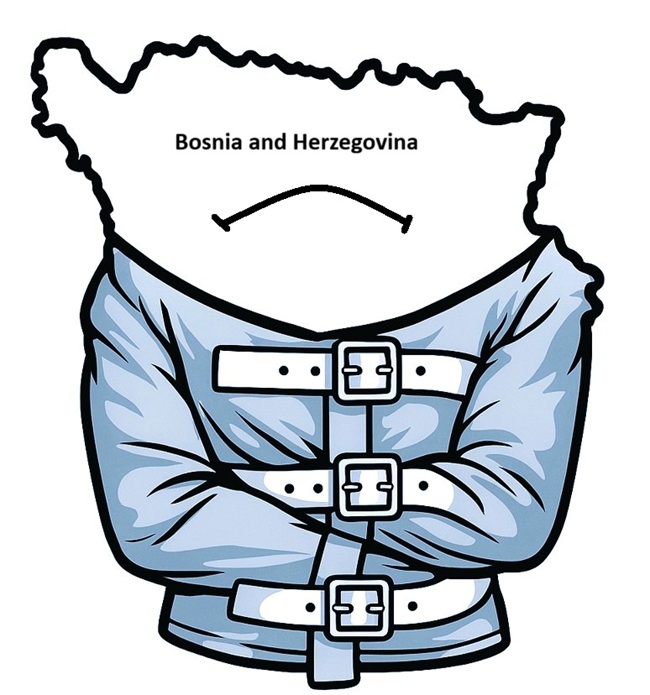
Taken together, these stories illustrate Bosnia’s paradox. A nation that endured a devastating war in the 1990s — marked by genocide, ethnic cleansing, and the displacement of over million people — remains bound by the Dayton Agreement, which institutionalized ethnic divisions and rewarded wartime territorial gains. The result is a political straitjacket: three ethnic groups wield veto powers to block reforms, corruption permeates governance, and prosperity is reserved for those tied to political elites.
While Bosnia contributes to peace abroad, its youth flee in search of opportunity, disillusioned by stagnation at home. Institutions like BHRT, meant to serve all citizens, are undermined by nationalist agendas. Even historical memory is contested, as seen in the classroom dispute over Izetbegović’s legacy.
Conclusion
Bosnia and Herzegovina is a state that cannot breathe freely. Its lungs are constrained by the tight belts of Dayton’s framework, corruption, and nationalist obstruction. International aid and oversight keep the system alive, but no one loosens the straps. The paradox endures: a country that helps build peace elsewhere remains unable to secure peace, unity, and prosperity within its own borders.
Personal Reflection
For those of us who were victims of ethnic cleansing, the paradox is not abstract. It is lived reality. The land we were forced to leave is now claimed exclusively by those who expelled us, while the state itself struggles to breathe under the weight of division and corruption. Every headline about collapsing institutions or contested history is not just politics — it is a reminder of the injustice that was never undone. Bosnia cannot move forward until it confronts this truth, and until the straitjacket of Dayton is loosened enough for all its people to breathe freely.
Author: Mel Reese
EMAIL ADDRESS:
melreese72[at]outlook[dot]com
Bosnia’s Paradox: News, Memory, and the Voice of a Survivor
Bosnia and Herzegovina today continues to embody contradictions that reveal both its potential and its fragility. Recent developments highlight the paradox of a country that has contributed to global peacekeeping missions while struggling to preserve its own institutions and collective memory.
Peacekeeping Abroad, Fragility at Home
At a press conference, Minister of Defense Zukan Helez announced that the Armed Forces of Bosnia and Herzegovina (AFBiH) may join a U.S.-led peacekeeping mission in Gaza. With specialized engineering, demining, and medical units, Bosnia’s contribution would be small but highly skilled. This follows a tradition: since 2001, more than 1,200 Bosnian soldiers have served in missions across Ethiopia, Iraq, Afghanistan, Congo, Mali, and the Central African Republic. Despite limited budgets, Bosnia has consistently shown readiness to support international stability.
Yet, while Bosnia’s soldiers prepare to safeguard peace abroad, its own public institutions face collapse. Employees of Radio Television of Bosnia and Herzegovina (BHRT) staged protests against years of political neglect and financial strangulation. BHRT, the only state-level public broadcaster, is burdened by debts exceeding 100 million BAM, largely due to violations of the broadcasting law by entity-level stations.
Journalists warn that the service is in its “last phase of collapse,” threatening the survival of independent journalism in the country. The protest, broadcast live under the slogan “Don’t Shut Down BHRT”, underscored the fight for truth and public interest in a system where politicians are seen as the very architects of dysfunction.
Contested Memory and Identity
Meanwhile, controversy erupted in Sarajevo when a teacher allegedly told students not to mention Bosnia’s first president, Alija Izetbegović, claiming he “sold the state.” The incident prompted an investigation by the Sarajevo Canton’s Minister of Education, who vowed to prevent historical revisionism in classrooms. This episode reflects Bosnia’s ongoing struggle with contested narratives of its past, where even the legacy of independence remains disputed.
The Paradox of Bosnia
Taken together, these stories illustrate Bosnia’s paradox. A nation that endured a devastating war in the 1990s — marked by genocide, ethnic cleansing, and the displacement of over million people — remains bound by the Dayton Agreement, which institutionalized ethnic divisions and rewarded wartime territorial gains. The result is a political straitjacket: three ethnic groups wield veto powers to block reforms, corruption permeates governance, and prosperity is reserved for those tied to political elites.
While Bosnia contributes to peace abroad, its youth flee in search of opportunity, disillusioned by stagnation at home. Institutions like BHRT, meant to serve all citizens, are undermined by nationalist agendas. Even historical memory is contested, as seen in the classroom dispute over Izetbegović’s legacy.
Conclusion
Bosnia and Herzegovina is a state that cannot breathe freely. Its lungs are constrained by the tight belts of Dayton’s framework, corruption, and nationalist obstruction. International aid and oversight keep the system alive, but no one loosens the straps. The paradox endures: a country that helps build peace elsewhere remains unable to secure peace, unity, and prosperity within its own borders.
Personal Reflection
For those of us who were victims of ethnic cleansing, the paradox is not abstract. It is lived reality. The land we were forced to leave is now claimed exclusively by those who expelled us, while the state itself struggles to breathe under the weight of division and corruption. Every headline about collapsing institutions or contested history is not just politics — it is a reminder of the injustice that was never undone. Bosnia cannot move forward until it confronts this truth, and until the straitjacket of Dayton is loosened enough for all its people to breathe freely.
Author: Mel Reese
EMAIL ADDRESS:
melreese72[at]outlook[dot]com