
The Global Crackdown in Silencing Pro-Palestinian Voices in Academia and Culture
Across universities, cultural institutions, and public platforms, a disturbing pattern is emerging: those who speak out against Israel are being silenced, punished, or vilified.
What should be a free exchange of ideas in democratic societies is increasingly met with retaliation, censorship, and intimidation.
The United States prides itself on being a beacon of free speech. Yet today, professors, students, and artists who dare to speak against Israel’s genocidal war in Gaza are finding themselves punished, surveilled, and erased. What we are witnessing is not isolated disciplinary action — it is a coordinated campaign of suppression.
At San José State University, tenured faculty member in justice studies, Sang Hea Kil was dismissed last month for her pro-Palestinian activism — the first tenured faculty member fired from a public university in connection to Gaza protests. Her dismissal recalls the 2014 firing of Steven Salaita at the University of Illinois, who lost his job over tweets condemning Israel’s bombing of Gaza.
Faculty unions have condemned these actions as blatant violations of academic freedom and free speech, yet the trend continues. Yet the pattern persists: dissent on Palestine is treated not as protected speech but as grounds for professional exile.
At UC Berkeley, computer science lecturer Peyrin Kao was suspended after allegedly using class time to discuss Gaza suffering. Kao had already staged a 38-day hunger strike in solidarity with Palestinians, making him a visible target. Civil rights groups warned that his suspension sends a chilling message: that speaking about Palestine — even in a public university bound by the First Amendment — will be met with retaliation. Kao himself called the discipline an “unconstitutional attack on free speech,” and his union has vowed to fight back.
In a statement urging UC Berkeley to reverse its decision, CAIR's executive director, Zahra Billoo said that "UC Berkeley's suspension of lecturer Kao sends a chilling message to students and faculty: Speaking about Gaza will be met with retaliation. That is unacceptable at any institution, but especially at a public university bound by the First Amendment."
Maura Finkelstein, professor from Muhlenberg College and Katherine Franke, a Columbia University law professor were also fired for same reasons.
The crackdown extends beyond academia. Artists are not spared. American singer, songwriter and dancer Kehlani has faced organized death threats and cancellations of performances after voicing support for Palestine. Cornell University’s president labeled her “antisemitic” and canceled her show, while San Francisco Pride dropped her from its lineup without explanation. Yet despite the backlash, Kehlani’s music continues to thrive — her single Folded earned Grammy nominations, proof that art can resist silencing even when the artist is targeted.
In the UK, pro-Palestine activist Natalie Strecker was dragged into court on charges of “supporting terrorism groups” after posting commentary in support of Palestine. Judge Sir John Saunders dismissed the case because there was no evidence to the claims, affirming her right to express personal opinions online.
Even the judiciary has been forced to intervene. A federal judge ordered the University of Florida to reinstate law student Preston Damsky, who had been expelled for controversial statements in academic papers about race and religion, and social media post calling for Jews to "be abolished."
Reuters reports stated that court order documents shows that Preston Damsky was suspended in April after writing on X platform that "My position on Jews is simple: whatever Harvard professor Noel Ignatiev meant by his call to 'abolish the White race by any means necessary' is what I think must be done with Jews. Jews must be abolished by any means necessary."
U.S. District Judge Allen Winsor ruled in Damsky's favor, granting a preliminary injunction requiring readmitted Damsky to the law school by December 1. Judge emphasized that UF did not show that Damsky's speech "constituted a true threat or was otherwise proscribable."
"The University, of course, has an interest in maintaining order, but it has no interest in violating the First Amendment to achieve that goal," Judge Winsor wrote explaining his decision.
A federal judge, U.S. District Judge Denise J. Casper allowed Tufts University student Romneyas Ozturk from Turkey, to resume her academic work after she was cast out from the TU and detained by ICE after her visa was revoked by the Trump administration, leading to six weeks of detention in Louisiana immigrant detention center.
Ozturk's alleged crime was an opinion piece in the campus newspaper that she and three other students wrote in collaboration criticized the university’s response to student activists demanding that Tufts acknowledge the Palestinian genocide, disclose its investments and divest from companies with ties to Israel.
Ozturk is one of the first foreign-born students that Trump administration began targeting for their pro-Palestinian advocacy. These rulings highlight the tension between institutional discipline and constitutional protections — and the growing role of courts in defending free expression against universities themselves.
Similarly, British punk-rap group Bob Vylan is suing Ireland’s RTE for defamation after their politically charged chant "Death, Death to the IDF" during a Glastonbury performance was mischaracterized as antisemitic.
The documents were filed by Phoenix Law which stated that Bob Vylan had made statements expressing support for Palestinian self-determination and criticizing military actions by the IDF in the "death, death to the IDF" chant. It said the comments did not target Jewish people or express hatred towards any group, adding: “The comments made were politically charged, but not antisemitic in nature.”
Their case underscores a crucial distinction: criticizing state violence is not the same as promoting hatred toward a people. Yet too often, that line is deliberately blurred to delegitimize dissent.
Taken together, these cases reveal a coordinated effort of Trump administration and Israel to suppress dissent. Professors lose their livelihoods, students face expulsion or detention, artists are threatened, and activists are dragged into courtrooms. Meanwhile, powerful Israeli networks like MOSSAD, ADL and CLEAR operate in the shadows — weaponizing surveillance, doxing, and intimidation to enforce silence. From healthcare data systems to facial recognition technologies, the infrastructure of control is vast and deeply embedded. Those who resist find themselves harassed, followed, or professionally destroyed.
This is not the behavior of a free, democratic, and sovereign state. It is the architecture of fear, designed to extinguish justice, erase dreams, and fracture communities. When governments and institutions prioritize silencing voices in order to hide the truth about Israel's genocide in Palestine over protecting freedoms, they risk replicating the very conditions of oppression they claim to oppose. Palestine becomes not only a place under siege but a mirror reflecting the erosion of liberty worldwide.
The lesson is clear: defending the right to speak truth to power is not optional — it is essential. If we allow intimidation and censorship to prevail, the world will not only fail Palestine; it will fail itself.
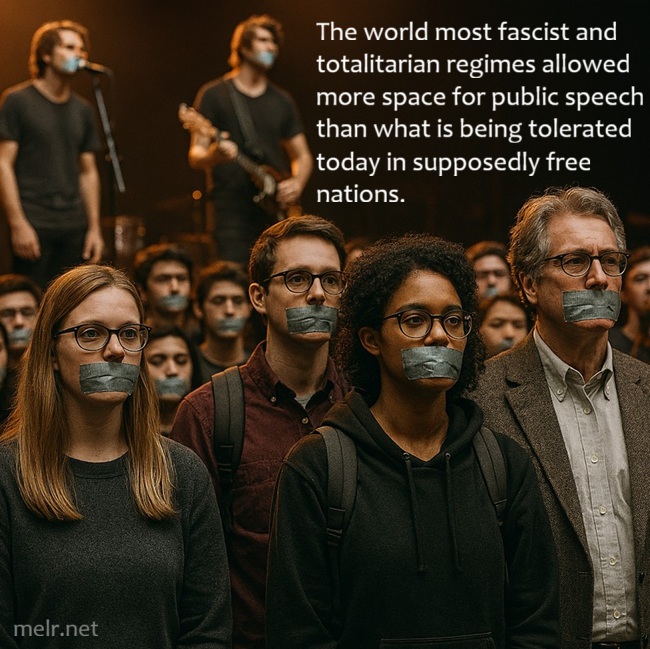
This campaign of silencing dissent must end. It is not the hallmark of a modern, democratic society to punish professors, students, and artists for speaking their conscience. When freedom of expression is curtailed so aggressively, we are forced to confront a chilling truth: even the world most fascist and totalitarian regimes allowed more space for public speech than what is being tolerated today in supposedly free nations.
If universities, governments, and cultural institutions continue down this path, they will not only betray the principles of democracy but also normalize authoritarian control. We cannot allow intimidation, censorship, and surveillance to become the new standard.
Readers, this is the moment to resist. Speak out, share, and refuse to be silenced. The erosion of free expression is not just about Palestine — it is about the future of liberty everywhere. If we fail to defend it now, we risk living in a world where Gaza is not an exception but the rule.
Author: Mel Reese
EMAIL ADDRESS:
melreese72[at]outlook[dot]com
Across universities, cultural institutions, and public platforms, a disturbing pattern is emerging: those who speak out against Israel are being silenced, punished, or vilified.
What should be a free exchange of ideas in democratic societies is increasingly met with retaliation, censorship, and intimidation.
The United States prides itself on being a beacon of free speech. Yet today, professors, students, and artists who dare to speak against Israel’s genocidal war in Gaza are finding themselves punished, surveilled, and erased. What we are witnessing is not isolated disciplinary action — it is a coordinated campaign of suppression.
At San José State University, tenured faculty member in justice studies, Sang Hea Kil was dismissed last month for her pro-Palestinian activism — the first tenured faculty member fired from a public university in connection to Gaza protests. Her dismissal recalls the 2014 firing of Steven Salaita at the University of Illinois, who lost his job over tweets condemning Israel’s bombing of Gaza.
Faculty unions have condemned these actions as blatant violations of academic freedom and free speech, yet the trend continues. Yet the pattern persists: dissent on Palestine is treated not as protected speech but as grounds for professional exile.
At UC Berkeley, computer science lecturer Peyrin Kao was suspended after allegedly using class time to discuss Gaza suffering. Kao had already staged a 38-day hunger strike in solidarity with Palestinians, making him a visible target. Civil rights groups warned that his suspension sends a chilling message: that speaking about Palestine — even in a public university bound by the First Amendment — will be met with retaliation. Kao himself called the discipline an “unconstitutional attack on free speech,” and his union has vowed to fight back.
In a statement urging UC Berkeley to reverse its decision, CAIR's executive director, Zahra Billoo said that "UC Berkeley's suspension of lecturer Kao sends a chilling message to students and faculty: Speaking about Gaza will be met with retaliation. That is unacceptable at any institution, but especially at a public university bound by the First Amendment."
Maura Finkelstein, professor from Muhlenberg College and Katherine Franke, a Columbia University law professor were also fired for same reasons.
The crackdown extends beyond academia. Artists are not spared. American singer, songwriter and dancer Kehlani has faced organized death threats and cancellations of performances after voicing support for Palestine. Cornell University’s president labeled her “antisemitic” and canceled her show, while San Francisco Pride dropped her from its lineup without explanation. Yet despite the backlash, Kehlani’s music continues to thrive — her single Folded earned Grammy nominations, proof that art can resist silencing even when the artist is targeted.
In the UK, pro-Palestine activist Natalie Strecker was dragged into court on charges of “supporting terrorism groups” after posting commentary in support of Palestine. Judge Sir John Saunders dismissed the case because there was no evidence to the claims, affirming her right to express personal opinions online.
Even the judiciary has been forced to intervene. A federal judge ordered the University of Florida to reinstate law student Preston Damsky, who had been expelled for controversial statements in academic papers about race and religion, and social media post calling for Jews to "be abolished."
Reuters reports stated that court order documents shows that Preston Damsky was suspended in April after writing on X platform that "My position on Jews is simple: whatever Harvard professor Noel Ignatiev meant by his call to 'abolish the White race by any means necessary' is what I think must be done with Jews. Jews must be abolished by any means necessary."
U.S. District Judge Allen Winsor ruled in Damsky's favor, granting a preliminary injunction requiring readmitted Damsky to the law school by December 1. Judge emphasized that UF did not show that Damsky's speech "constituted a true threat or was otherwise proscribable."
"The University, of course, has an interest in maintaining order, but it has no interest in violating the First Amendment to achieve that goal," Judge Winsor wrote explaining his decision.
A federal judge, U.S. District Judge Denise J. Casper allowed Tufts University student Romneyas Ozturk from Turkey, to resume her academic work after she was cast out from the TU and detained by ICE after her visa was revoked by the Trump administration, leading to six weeks of detention in Louisiana immigrant detention center.
Ozturk's alleged crime was an opinion piece in the campus newspaper that she and three other students wrote in collaboration criticized the university’s response to student activists demanding that Tufts acknowledge the Palestinian genocide, disclose its investments and divest from companies with ties to Israel.
Ozturk is one of the first foreign-born students that Trump administration began targeting for their pro-Palestinian advocacy. These rulings highlight the tension between institutional discipline and constitutional protections — and the growing role of courts in defending free expression against universities themselves.
Similarly, British punk-rap group Bob Vylan is suing Ireland’s RTE for defamation after their politically charged chant "Death, Death to the IDF" during a Glastonbury performance was mischaracterized as antisemitic.
The documents were filed by Phoenix Law which stated that Bob Vylan had made statements expressing support for Palestinian self-determination and criticizing military actions by the IDF in the "death, death to the IDF" chant. It said the comments did not target Jewish people or express hatred towards any group, adding: “The comments made were politically charged, but not antisemitic in nature.”
Their case underscores a crucial distinction: criticizing state violence is not the same as promoting hatred toward a people. Yet too often, that line is deliberately blurred to delegitimize dissent.
Taken together, these cases reveal a coordinated effort of Trump administration and Israel to suppress dissent. Professors lose their livelihoods, students face expulsion or detention, artists are threatened, and activists are dragged into courtrooms. Meanwhile, powerful Israeli networks like MOSSAD, ADL and CLEAR operate in the shadows — weaponizing surveillance, doxing, and intimidation to enforce silence. From healthcare data systems to facial recognition technologies, the infrastructure of control is vast and deeply embedded. Those who resist find themselves harassed, followed, or professionally destroyed.
This is not the behavior of a free, democratic, and sovereign state. It is the architecture of fear, designed to extinguish justice, erase dreams, and fracture communities. When governments and institutions prioritize silencing voices in order to hide the truth about Israel's genocide in Palestine over protecting freedoms, they risk replicating the very conditions of oppression they claim to oppose. Palestine becomes not only a place under siege but a mirror reflecting the erosion of liberty worldwide.
The lesson is clear: defending the right to speak truth to power is not optional — it is essential. If we allow intimidation and censorship to prevail, the world will not only fail Palestine; it will fail itself.
This campaign of silencing dissent must end. It is not the hallmark of a modern, democratic society to punish professors, students, and artists for speaking their conscience. When freedom of expression is curtailed so aggressively, we are forced to confront a chilling truth: even the world most fascist and totalitarian regimes allowed more space for public speech than what is being tolerated today in supposedly free nations.
If universities, governments, and cultural institutions continue down this path, they will not only betray the principles of democracy but also normalize authoritarian control. We cannot allow intimidation, censorship, and surveillance to become the new standard.
Readers, this is the moment to resist. Speak out, share, and refuse to be silenced. The erosion of free expression is not just about Palestine — it is about the future of liberty everywhere. If we fail to defend it now, we risk living in a world where Gaza is not an exception but the rule.
Author: Mel Reese
EMAIL ADDRESS:
melreese72[at]outlook[dot]com